Au lieu d'introduire
Tout d'abord, je voudrais exprimer ma gratitude à tous ceux qui ont répondu au premier article sur l'optimisation de code en C/C++ en utilisant l'exemple d'une fonction permettant de calculer la racine carrée d'un entier arrondi à l'entier le plus proche. Grâce à l'attention d'experts, une faute de frappe dans le texte a été corrigée ; la tirelire d'algorithmes efficaces a été reconstituée.
Un algorithme intéressant est sqrxi32 de @ Sdima1357 - Exemple 1, ci-après dénommé "_i32" par souci de concision. L'algorithme "_i32" remplit inconditionnellement la condition de la tâche principale - "arrondir à l'entier le plus proche" - sur l'ensemble des valeurs d'argument [0 .. 0xFFFFFFFF], tout en affichant des performances élevées.
Exemple 1 : Calcul de la racine carrée d'un entier, arrondie à l'entier le plus proche.
uint16_t sqrxi32( uint32_t y )
{
if ( y == 1 )
return 1;
uint32_t xh = y > 0x10000ul ? 0x10000ul : y;
uint32_t xl = 0;
uint32_t xc;
for ( int k = 0; k < 16; k++ )
{
xc = ( xh + xl ) >> 1ul;
if ( xc * xc - xc >= y )
{
xh = xc;
}
else
{
xl = xc;
}
}
return ( xh + xl ) >> 1ul;
}
Une autre bonne qualité de l'algorithme "_i32" est sa prévisibilité temporelle. Le temps d'exécution "_i32" est constant, contrairement à l'algorithme "_evn" qui consomme du temps machine proportionnellement au module de l'argument.
De quoi parle le texte
Observez l'effet complexe des paramètres de construction et de la plate-forme matérielle cible sur les performances finales, lorsqu'il est appliqué au même code source.
Le code source contient une solution à un problème avec différents algorithmes.
.
:
— 3 ;
— 3
:
( main.c)
-
: CubeIDE ( Eclipce CDT)
RELEASE CubeIDE
: «ISO C11 + gnu extensions» (-std=gnu11)
:
CubeMX — default settings, +48MHz, +USART1, +HAL;
Runtime lib: Reduced C ( --spec=nano.specs );
Use float with printf from new lib nano ( -u _printf_float );
1:

2:

3:
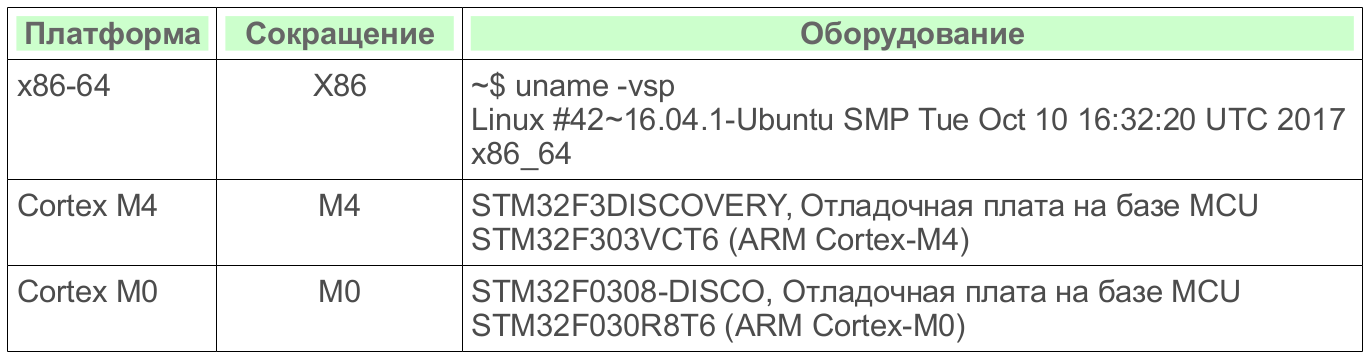
FPU «M4» sqrt_fps, (float), «_fps» (Float Point Short) — 2.
2: float
uint16_t sqrt_fps( uint32_t number )
{
if ( number < 2 )
return (uint16_t) number;
float f_rslt = sqrtf( number );
uint32_t rslt = (uint32_t) f_rslt;
if ( !( f_rslt - (float) rslt < .5 ) )
rslt++;
return (uint16_t) rslt;
}
«_fps» 22- , 1E+5 — 1.
1: "_fps" 1E+6+

[0 .. 1E+5].
4:
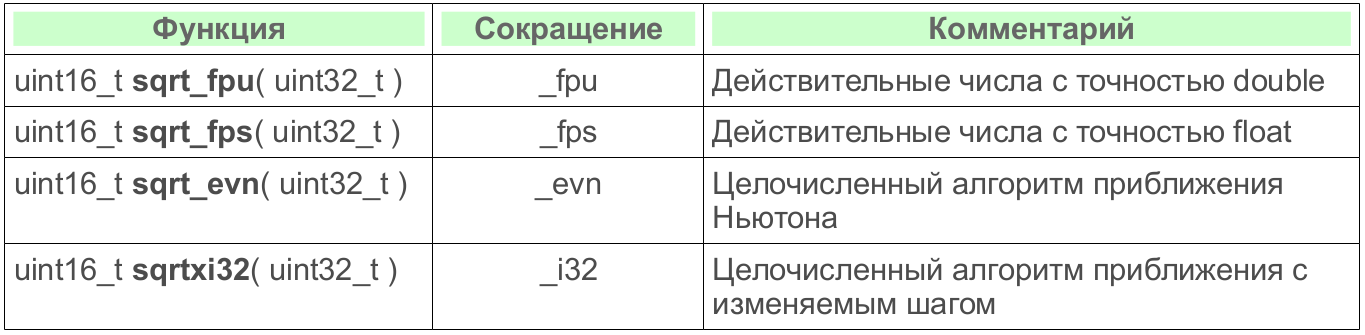
— , .
, «x86» «ARM Cortex» . — 2.
2:
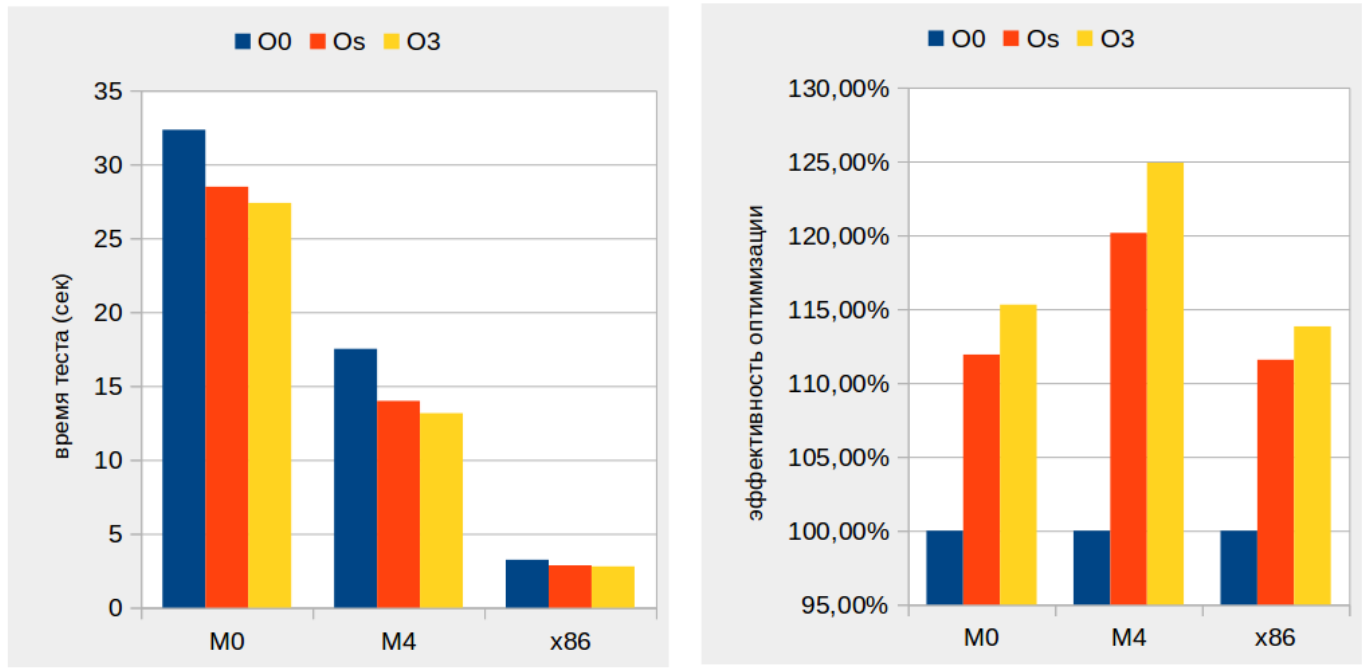
Y ( 4), . X — .
( 2), , .
, , , : -O0, -Os, -O3.
( 2) : -O0, -Os, -O3.
100% , ( -O0 ). .
( ‑O0 ) , - .
«M4».
x86
( 3) Y . X — ( 4).
, .
X . .
3: x86

«x86» .
.
( ‑O0 ) 39% «_fpu» ( ‑Os ) 16% «_fps» ( ‑O3 ). , «x86» .
, -O3 -Os.
M4
«M4» ( 4).
4: M4

«M4» «_fps», — float.
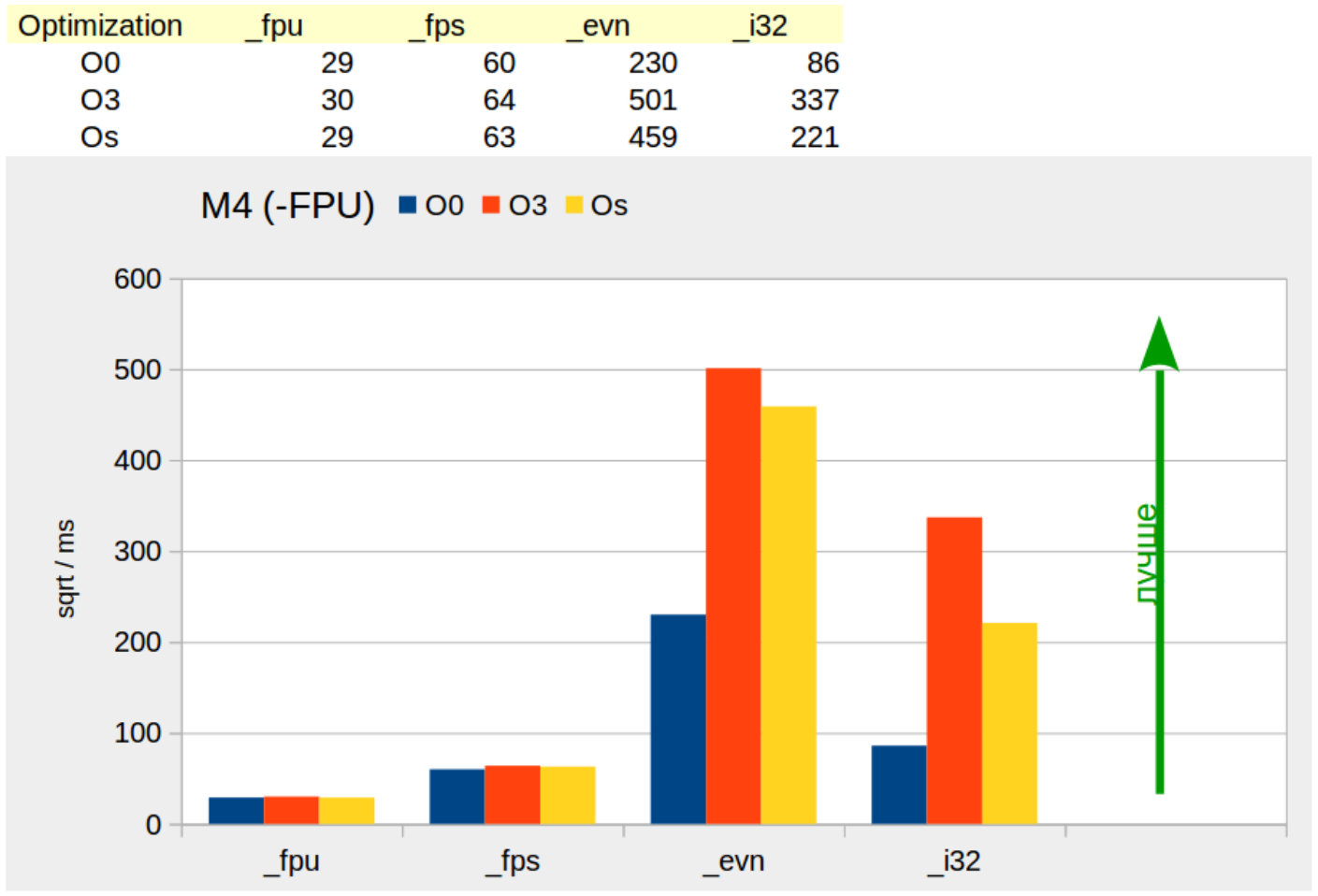
FPU «M4» — 5.
, «_fps» 1E+5 (. 1) , FPU «M4» .
5: M4 FPU
M0
«M0» «M4» FPU ( 5), — 6.
, «M4», «M0» — 48 MHz. , «M0» , «M4», .
6: M0
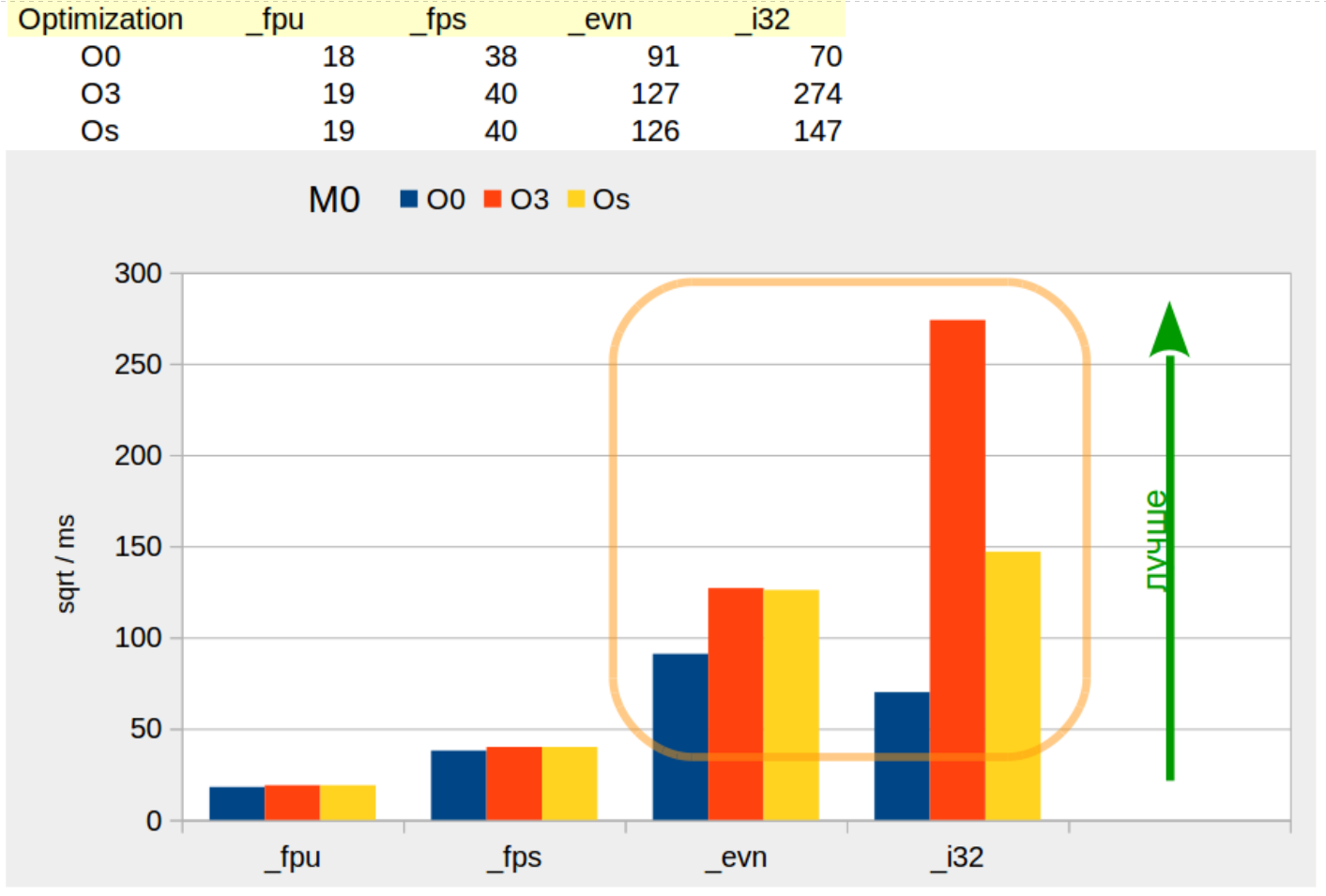
«_fps» «M0» «_fpu».
.
( 6) .
( ‑O0 ) «_evn» «_i32». «_evn» , «_i32», .
. , «M4» «x86» .
.
, , ( 3 6).
.
, , . .
1. x86
CubeIDE (Eclipse CDT) C
— 3
sqrt_cmp.h — 6
:
IDE;
— 4
( -O0, -O3, -Os ) .
3: x86 — main.c
#include "sqrt_cmp.h"
int main( void )
{
main_Of_SqrtComp();
return 0;
}
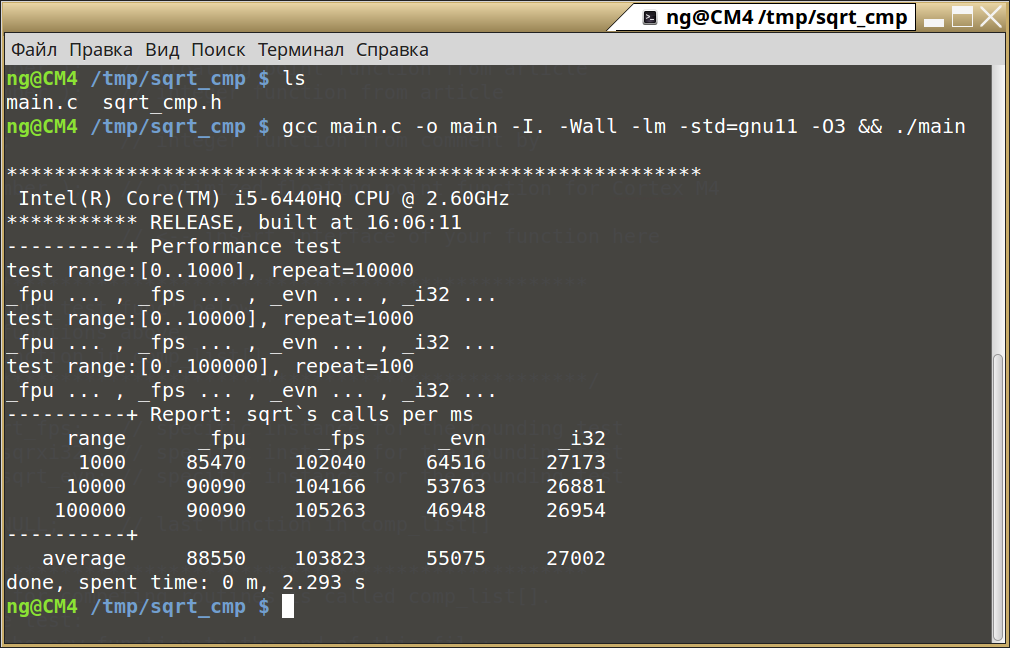
4 x86
gcc main.c -o main -I. -Wall -lm -std=gnu11 -O3 && ./main
«x86» , main.c sqrt_cmp.h , (pwd).
7: «x86»
2. STM32
CubeIDE STM32 (CubeMX)
sqrt_cmp.h STM32 — 6
sqrt_cmp.h main.c — 5
IDE
Changer le type d'optimisation (-O0, -O3, -Os) observer le résultat
Exemple 5 : Code source pour STM32 (avec des lacunes <...>) - main.c
< … >
/* Private includes ----------------------------------------------------------*/
/* USER CODE BEGIN Includes */
#include "sqrt_cmp.h"
/* USER CODE END Includes */
< … >
/**
* @brief The application entry point.
* @retval int
*/
int main(void)
{
< … >
/* Infinite loop */
/* USER CODE BEGIN WHILE */
main_Of_SqrtComp();
while (1)
{
/* USER CODE END WHILE */
/* USER CODE BEGIN 3 */
}
/* USER CODE END 3 */
Annexe 3. Procédure de test d'autres algorithmes et plateformes
L'assemblage de test pour d'autres plateformes est effectué par analogie.
Pour les plates-formes matérielles autres que celles mentionnées ci-dessus (tableau 3), une modification cosmétique du fichier "sqrt_cmp.h" est susceptible d'être nécessaire.
Exemple 6 : Contenu du fichier sqrt_cmp.h
/******************************************************************************
* File: sqrt_cmp.h Created on 5 . 2020 .
* CC0 1.0 Universal (CC0 1.0)
* Creative Commons Public Domain Dedication
* No Copyright
*
* TAB Size .EQ 4
********************************************************************************/
#ifndef __SQRT_CMP_H
#define __SQRT_CMP_H
#include <math.h>
#include <stdio.h>
#include <stdint.h>
#ifdef __cplusplus
extern "C" {
#endif
/******************************************************************************
* Interface of the entry point for all sqrt tests
******************************************************************************/
void main_Of_SqrtComp();
/******************************************************************************
* test case selection: TEST_SET
* select one of the test suite via a comment.
******************************************************************************/
#define TEST_SET TEST_ALL
//#define TEST_SET TEST_ROUNDING
//#define TEST_SET TEST_PERFORMANCE
/******************************************************************************
* Interfaces of test functions.
* See implementation of them at the end of this file.
******************************************************************************/
typedef uint16_t (*sqrt_func)( uint32_t number );
uint16_t sqrt_fpu( uint32_t number ); // floating point function from article
uint16_t sqrt_evn( uint32_t number ); // integer function from article
uint16_t sqrxi32( uint32_t y ); // integer function from comment by
uint16_t sqrt_fps( uint32_t number ); // optimized floating point function for Cortex M4
// <-- insert interface of your function here
/******************************************************************************
* Set to variable named as 'round_test_func' below
* to the alias of one of the functions above.
* The NULL will select last function in comp_list[]
******************************************************************************/
sqrt_func round_test_func = sqrt_fps; // specific instance for the rounding test
//sqrt_func round_test_func = sqrxi32; // specific instance for the rounding test
//sqrt_func round_test_func = sqrt_evn; // specific instance for the rounding test
//sqrt_func round_test_func = NULL; // last function in comp_list[]
/******************************************************************************
* The array of test functions for competing routines is called comp_list[].
* Adding a new function to the test:
- copy the implementation of the new function to the end of this file;
- declare the function interface at the beginning of this file;
- add the alias and declaration of the new function to
end of array named comp_list[].
******************************************************************************/
// @formatter:off
typedef struct
{
sqrt_func fsqrt;
char * alias;
} SCompFunc;
SCompFunc comp_list[] = // competition list
{
{ sqrt_fpu, "_fpu" },
{ sqrt_fps, "_fps" },
{ sqrt_evn, "_evn" },
{ sqrxi32, "_i32" }
// <-- insert your function name & alias here
};
/* @formatter:on */
/******************************************************************************
* Platform-independent definitions
******************************************************************************/
#define PUT_FORMAT_MSG(f_, ...) { \
sprintf( (char *)s_buf, (char *)f_, ##__VA_ARGS__ ); \
PUT_MSG( (char *)s_buf ); }
#define MS_PER_SEC 1000
#define US_PER_SEC ( MS_PER_SEC * MS_PER_SEC )
#define ARRAY_SIZE(a) (sizeof a / sizeof *a) // size of static array at runtime
#define SIRV(f) if ( f ) ; // suppress Ignore Return Value warning
/******************************************************************************
* Platform-specific defines
******************************************************************************/
#if defined( USE_HAL_DRIVER ) // STM32 ARM Cortex platform
# include <string.h>
# include "main.h"
//*****************************************************************************
// Platform-specific defines for the helper functions
# define SCALE_RATE 1 // must be .GE than 1
# define X_CLOCK HAL_GetTick()
# define X_DELAY( ms ) HAL_Delay( ms )
//*****************************************************************************
// Platform-specific defines for the terminal output
# define USART_HANDLE huart1 // set valid USART handler alias here defined by the config of MCU
# define USART_TIMEOUT 150 // max timeout for HAL_UART_Transmit
extern UART_HandleTypeDef USART_HANDLE;
extern HAL_StatusTypeDef HAL_UART_Transmit ( UART_HandleTypeDef *huart, uint8_t *pData, uint16_t Size, uint32_t Timeout );
# define PUT_MSG( msg ) \
HAL_UART_Transmit( &USART_HANDLE, (uint8_t *)msg, strlen( (char *)msg ), USART_TIMEOUT )
# define CPU_CLOCK_MHz ( SystemCoreClock / US_PER_SEC ) // CPU CLK in MHz
# if defined( STM32F0 )
# define CPU_ID ( "STM32 ARM Cortex M0" )
# elif defined ( STM32F3 )
# define CPU_ID ( "STM32 ARM Cortex M4" )
# else
# define CPU_ID ( "Maybe STM32 ARM Cortex" )
# endif
# define PUT_SYS_INFO PUT_FORMAT_MSG( " %s @ "fdU()" MHz\n", CPU_ID, CPU_CLOCK_MHz )
#else // #if defined( USE_HAL_DRIVER )
# include <time.h>
# include <stdlib.h>
//*****************************************************************************
// Platform-specific defines for the helper functions
# define SCALE_RATE 100 // must be .GE than 1
# define X_CLOCK (uint32_t) x_clock()
# define X_DELAY( ms ) x_delay( ms )
uint32_t x_clock()
{
uint64_t result = (uint64_t) clock();
result *= MS_PER_SEC;
result /= CLOCKS_PER_SEC;
return (uint32_t) result;
}
void x_delay( uint32_t ms )
{
uint64_t tm = x_clock();
while ( ( x_clock() - tm ) < ms )
;
}
//*****************************************************************************
// Platform-specific defines for the terminal output
# define PUT_MSG( msg ) \
printf( "%s", (char *)msg ), fflush ( stdout );
# if defined( __unix__ ) // anybody other platform for gcc
# define PUT_SYS_INFO SIRV( system( "cat /proc/cpuinfo | grep 'model name' | head -1 | sed s/'model name\t:'/''/" ) )
# else
# define PUT_SYS_INFO PUT_MSG( "Undefined System & CPU" )
# endif // # if defined( __unix__ ) // anybody other platform for gcc
#endif // #if defined( USE_HAL_DRIVER )
#if ( __WORDSIZE == 64 )
# define fdI(s) "%" #s "d"
# define fdU(s) "%" #s "u"
# define fdX(s) "%" #s "x"
#else // let's say __WORDSIZE == 32
# define fdI(s) "%" #s "ld"
# define fdU(s) "%" #s "lu"
# define fdX(s) "%" #s "lx"
#endif // #if ( __WORDSIZE == 64 )
#if defined ( DEBUG ) || defined ( _DEBUG ) // chk build mode of CubeIDE
# define BUILD_MODE "DEBUG"
#else // Maybe Release
# define BUILD_MODE "RELEASE"
#endif // #if defined ( DEBUG ) || defined ( _DEBUG )
/******************************************************************************
* the helper data with testing ranges
******************************************************************************/
// @formatter:off
typedef struct
{
uint32_t start;
uint32_t stop;
uint32_t repeat;
} STestRange;
STestRange test_rngs[] =
{
{ 0, 1000, 100 * SCALE_RATE },
{ 0, 10000, 10 * SCALE_RATE },
{ 0, 100000, 1 * SCALE_RATE }
};
uint32_t test_results[ARRAY_SIZE( test_rngs )][ARRAY_SIZE( comp_list ) + 1];
#define MSG_BUFF_SIZE 512
uint8_t s_buf[MSG_BUFF_SIZE]; // buffer for a terminal output
/* @formatter:on */
/******************************************************************************
* Test sets definitions. Do not change it.
******************************************************************************/
#define TEST_ROUNDING 1
#define TEST_PERFORMANCE 2
#define TEST_ALL ( TEST_ROUNDING | TEST_PERFORMANCE )
#ifndef TEST_SET
# define TEST_SET TEST_ALL
#endif
#define HI_ROUND_TEST_RANGE_END 0x007FFFFFUL
#define HI_ROUND_TEST_RANGE_START ( HI_ROUND_TEST_RANGE_END >> 4 )
/******************************************************************************
* Interface of helper functions
******************************************************************************/
void main_Header();
void testRounding();
void testPerformance();
/******************************************************************************
* Implementation of the entry point for all sqrt tests
******************************************************************************/
void main_Of_SqrtComp()
{
X_DELAY( MS_PER_SEC / 2 ); // suppress the output of a previous instance
// while the new instance is loading into the MCU
uint32_t start_time = X_CLOCK;
main_Header();
// checking normal and extended ranges for rounding
if ( TEST_SET & TEST_ROUNDING )
testRounding();
// checking normal ranges on execution time
if ( TEST_SET & TEST_PERFORMANCE )
testPerformance();
uint32_t test_time = X_CLOCK - start_time;
uint32_t test_m = ( test_time / MS_PER_SEC ) / 60;
uint32_t test_s = ( test_time / MS_PER_SEC ) % 60;
uint32_t test_ms = test_time % MS_PER_SEC;
PUT_FORMAT_MSG( "\ndone, spent time: "fdU()" m, "fdU()"."fdU()" s\n", test_m, test_s, test_ms );
}
/******************************************************************************
* Implementation of the helper functions
******************************************************************************/
void main_Header()
{
PUT_MSG( "\n\n**********************************************************\n" );
PUT_SYS_INFO;
PUT_FORMAT_MSG( "*********** %s, built at %s\n", BUILD_MODE, __TIME__ );
}
void testPerformance()
{
uint32_t i_func, i_rpt, i_rng;
uint32_t number, first, second, diff;
uint64_t temp;
PUT_MSG( "----------+ Performance test" );
for ( i_rng = 0; i_rng < ARRAY_SIZE( test_rngs ); i_rng++ )
{
PUT_MSG( "\n" );
PUT_FORMAT_MSG( "test range:["fdU()".."fdU()"], repeat="fdU()"\n", test_rngs[i_rng].start, test_rngs[i_rng].stop,
test_rngs[i_rng].repeat );
test_results[i_rng][0] = test_rngs[i_rng].stop;
for ( i_func = 0; i_func < ARRAY_SIZE( comp_list ); i_func++ )
{
PUT_FORMAT_MSG( "%s ... ", comp_list[i_func].alias );
first = X_CLOCK;
for ( i_rpt = 0; i_rpt < test_rngs[i_rng].repeat; i_rpt++ )
for ( number = test_rngs[i_rng].start; number < test_rngs[i_rng].stop; number++ )
comp_list[i_func].fsqrt( number );
second = X_CLOCK;
diff = second - first;
temp = ( test_rngs[i_rng].stop - test_rngs[i_rng].start ) * test_rngs[i_rng].repeat;
test_results[i_rng][i_func + 1] = (uint32_t) ( temp / diff );
if ( i_func < ARRAY_SIZE( comp_list ) - 1 )
PUT_MSG( ", " );
}
}
// small report
PUT_FORMAT_MSG( "\n----------+ Report: sqrt`s calls per ms\n%10s", "range" );
for ( i_func = 0; i_func < ARRAY_SIZE( comp_list ); i_func++ )
PUT_FORMAT_MSG( "%10s", comp_list[i_func].alias );
for ( i_rng = 0; i_rng < ARRAY_SIZE( test_rngs ); i_rng++ )
{
PUT_MSG( "\n" );
for ( i_func = 0; i_func < ARRAY_SIZE( comp_list ) + 1; i_func++ )
PUT_FORMAT_MSG( fdU( 10 ), test_results[i_rng][i_func] );
}
PUT_FORMAT_MSG( "\n----------+\n%10s", "average" );
for ( i_func = 0; i_func < ARRAY_SIZE( comp_list ); i_func++ )
{
temp = 0;
for ( i_rng = 0; i_rng < ARRAY_SIZE( test_rngs ); i_rng++ )
temp += test_results[i_rng][i_func + 1];
temp /= ARRAY_SIZE( test_rngs );
PUT_FORMAT_MSG( fdU( 10 ), (uint32_t)temp );
}
}
void testRoundingFunction( uint32_t start, uint32_t finish, sqrt_func psqrt, char *fname );
void testRounding()
{
uint16_t i_rng;
uint16_t f_rng;
PUT_MSG( "----------+ Rounding test\n" );
// checking the existence for the test function
for ( f_rng = 0; f_rng < ARRAY_SIZE( comp_list ); f_rng++ )
if ( comp_list[f_rng].fsqrt == round_test_func )
break;
if ( !( f_rng < ARRAY_SIZE( comp_list ) ) )
{
f_rng = ARRAY_SIZE( comp_list ) - 1;
PUT_FORMAT_MSG( "Value of 'round_test_func' not found.\n" );
}
PUT_FORMAT_MSG( "Function '%s' is tested for rounding.\n", comp_list[f_rng].alias );
// checking standard ranges
for ( i_rng = 0; i_rng < ARRAY_SIZE( test_rngs ); i_rng++ )
testRoundingFunction( test_rngs[i_rng].start, test_rngs[i_rng].stop, comp_list[f_rng].fsqrt, comp_list[f_rng].alias );
// checking extended range
testRoundingFunction( HI_ROUND_TEST_RANGE_START, HI_ROUND_TEST_RANGE_END, comp_list[f_rng].fsqrt, comp_list[f_rng].alias );
}
void turn_the_fan( uint32_t ms );
void testRoundingFunction( uint32_t start, uint32_t finish, sqrt_func psqrt, char *fname )
{
uint32_t rf, ri;
uint32_t n, c = 0;
PUT_FORMAT_MSG( "test range:["fdU( 10 )".."fdU( 10 )"] ... ", start, finish );
for ( n = start; n < finish; n++ )
{
rf = sqrt_fpu( n );
ri = ( *psqrt )( n );
if ( rf != ri )
{
if ( c++ > 3 )
{
PUT_FORMAT_MSG( "\b\n(!)too many mistakes in '%s', ", fname );
break;
}
else
{
double d = sqrt( (double) n );
PUT_FORMAT_MSG( "\b\n%s("fdU( 10 )")="fdU()" != "fdU(), fname, n, ri, rf );
PUT_FORMAT_MSG( " (real value is %.6lf)", d );
}
}
turn_the_fan( MS_PER_SEC );
}
if ( !c )
{
PUT_FORMAT_MSG( "\b done.\n" );
}
else
{
PUT_FORMAT_MSG( "test failed.\n" );
}
}
void turn_the_fan( uint32_t ms )
{
static char ca[] = "|/-\\";
static uint32_t cs = ARRAY_SIZE(ca) - 1;
static uint32_t cn = 0;
static uint32_t at = 0;
uint32_t ct = X_CLOCK;
if ( ct - at > ms )
{
at = ct;
PUT_FORMAT_MSG( "\b%c", ca[cn++ % cs] );
}
}
/******************************************************************************
* Implementation of the sqrt functions
******************************************************************************/
// floating point arg & result with double
uint16_t sqrt_fpu( uint32_t number )
{
if ( number < 2 )
return (uint16_t) number;
double f_rslt = sqrt( number );
uint32_t rslt = (uint32_t) f_rslt;
if ( !( f_rslt - (double) rslt < .5 ) )
rslt++;
return (uint16_t) rslt;
}
// floating point arg & result with float
uint16_t sqrt_fps( uint32_t number )
{
if ( number < 2 )
return (uint16_t) number;
float f_rslt = sqrtf( number );
uint32_t rslt = (uint32_t) f_rslt;
if ( !( f_rslt - (float) rslt < .5 ) )
rslt++;
return (uint16_t) rslt;
}
// unsigned integer arg & result
// @formatter:off
uint16_t sqrt_evn ( uint32_t number )
{
if ( number < 2 )
return ( uint16_t ) number;
uint32_t temp;
uint32_t div;
uint32_t rslt;
if ( number & 0xFFFF0000L )
if ( number & 0xFF000000L )
if ( number & 0xF0000000L )
if ( number & 0xE0000000L )
div = 43771;
else
div = 22250;
else
if ( number & 0x0C000000L )
div = 11310;
else
div = 5749;
else
if ( number & 0x00F00000L )
if ( number & 0x00C00000L )
div = 2923;
else
div = 1486;
else
if ( number & 0x000C0000L )
div = 755;
else
div = 384;
else
if ( number & 0xFF00L )
if ( number & 0xF000L )
if ( number & 0xC000L )
div = 195;
else
div = 99;
else
if ( number & 0x0C00L )
div = 50;
else
div = 25;
else
if ( number & 0xF0L )
if ( number & 0x80L )
div = 13;
else
div = 7;
else
div = 3;
rslt = number;
while ( 1 )
{
temp = number / div;
temp += div;
div = temp >> 1;
div += temp & 1;
if ( rslt > div )
rslt = div;
else
{
if ( number / rslt == rslt - 1 && number % rslt == 0 )
rslt--;
return ( uint16_t ) rslt;
}
}
}
/* @formatter:on */
// unsigned integer arg & result
uint16_t sqrxi32( uint32_t y )
{
if ( y == 1 )
return 1;
uint32_t xh = y > 0x10000ul ? 0x10000ul : y;
uint32_t xl = 0;
uint32_t xc;
for ( int k = 0; k < 16; k++ )
{
xc = ( xh + xl ) >> 1ul;
if ( xc * xc - xc >= y )
{
xh = xc;
}
else
{
xl = xc;
}
}
return ( xh + xl ) >> 1ul;
}
// <-- insert implementation of your function sqrt here
#ifdef __cplusplus
}
#endif
#endif // __SQRT_CMP_H